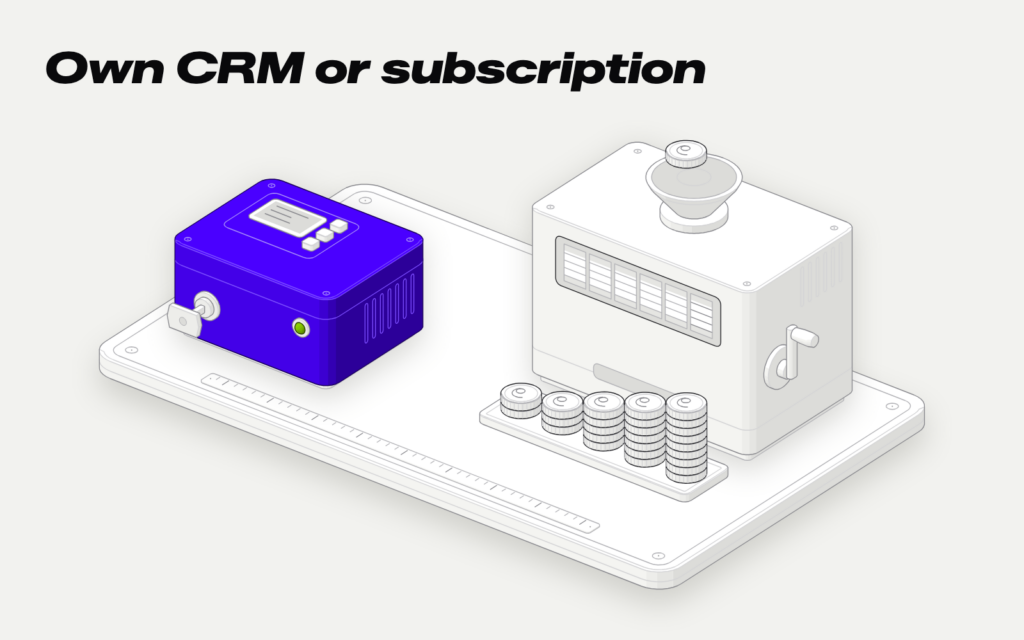
If you're a small team and sell like most businesses, Salesforce or HubSpot work for you and you can get started sooner. Custom CRM software makes sense when you're paying for many licenses, when your sales process doesn't fit the standard system, or when it needs to connect with proprietary software. With us, it starts at €9,000 + VAT and has no per-user fee.
We build custom CRMs, and even so, there are cases where we’ll tell you to get a subscription CRM. Here’s how each one charges, when it’s a good fit, and the four questions that usually decide it.
How Salesforce and HubSpot charge
Both charge a monthly per-user license. The feature level and price change with each edition. These are the published list prices, checked on 19 October 2026:
| CRM | Edition | List price |
|---|---|---|
| Salesforce (Sales) | The simplest | €25 per user per month |
| Salesforce (Sales) | The most complete | €550 per user per month |
| HubSpot | Sales Hub Pro | 100 USD per license per month |
| HubSpot | Sales Hub Enterprise | 150 USD per license per month |
There are editions in between these two ends. What matters for comparison is how they charge: the cost grows with each person who joins the team and repeats every year.
A custom CRM works the other way around. You pay for development once, starting at €9,000 + VAT, and then for maintenance, billed separately and not based on how many people use it. In how much a custom CRM costs you'll see what drives up that price and how to calculate it with your team.
When a subscription CRM makes sense
We recommend it if almost all of these conditions apply:
- There are only a few of you using it, and you’re not going to grow much over the next two years.
- You sell through a simple funnel: a contact comes in, gets qualified, a proposal is sent, and the deal closes.
- You only need to connect the usual tools: email, your calendar, and a well-known email marketing tool.
- You need to get started next week.
- You don’t have industry-specific data that the CRM needs to understand, such as construction projects, insurance policies, properties, or machines.
In that case, the off-the-shelf option costs less upfront, and you save development time. If it falls short a year from now, you can always move your data to another one.
When a custom CRM is worth it
It starts to make sense when two or more of these apply:
- You pay for a lot of licenses and only use part of what they include.
- Your funnel has several paths depending on the product, channel, or customer type.
- Your quotes have different rates by customer or discounts with specific rules.
- You need to connect it to a custom or legacy program without an out-of-the-box connector.
- Your sales reps work in the field and need screens designed for mobile.
- You want your website, bookings, and WhatsApp to flow into the CRM without copying anything.
When two or more apply, forcing an out-of-the-box CRM usually gets expensive: higher-tier editions to get the missing feature, paid connectors, consultants to adapt it, and a team that only uses part of it. On the custom CRM page, you can see what ours includes and how we build it.
If you need your own record types
This is the most specific question we get about HubSpot: whether it can create custom objects, meaning records specific to your industry in addition to contacts, companies, and deals. It can, but not in every edition. According to its knowledge base, custom objects are available in Enterprise subscriptions.
For a company that needs, for example, one record per project or rented machine, that means moving to the 150 USD per user per month Sales Hub Enterprise license. From there, the numbers change a lot compared with a CRM built around those records from the start.
Salesforce is the same as any out-of-the-box CRM: before you sign, ask which edition includes the feature you need and who will configure and maintain it.
The account with ten sales reps
Let's take a team of ten people and calculate only the license costs, using the list prices above:
| Option | Per year | Over three years |
|---|---|---|
| Salesforce edition at €100 per user per month | €12,000 | €36,000 |
| HubSpot Sales Hub Pro | 12,000 USD | 36,000 USD |
| HubSpot Sales Hub Enterprise | 18,000 USD | 54,000 USD |
All three leave out setup, connectors, and the cost of adapting the system. With custom CRM software, the calculation is development, from €9,000 + VAT, plus maintenance for those three years, which we provide in writing in the quote.
With these numbers, there is no single answer. If the Pro edition is enough for you and you are not planning to grow, the subscription is reasonable. If you need Enterprise just for one feature, or the team is going to double in size, the difference becomes significant. Run the numbers with your number of people and the edition you actually need.
The four questions that decide
- Can your sales process fit into the out-of-the-box CRM as it is? If you have to change how you work to make it fit, that change also costs money.
- How much will you pay over three years, not just the first month? Add up licenses, implementation, connectors, and customizations for the out-of-the-box CRM. Add development and maintenance for your own CRM.
- How long does it take you to change something? A new field, another step in the funnel, or a report. With the out-of-the-box CRM, it depends on the edition and who configures it. With your own CRM, it depends on what you agree on for maintenance.
- How do you get your data out if you leave one day? Ask before you sign, whichever CRM you choose. With ours, the data is yours and you can export it whenever you want.
If you answer all four with numbers, the decision almost makes itself.
The middle option
You do not always have to choose. Some companies keep HubSpot or Salesforce for day-to-day sales and build only the part that the out-of-the-box CRM does not cover: a quote configurator, a customer portal, or a connection to a custom program. The two parts communicate through an API.
It works well if the out-of-the-box part fits your needs and what is missing is specific. If what is missing is half the CRM, you end up paying for licenses and development at the same time. We explain how these connections work in CRM integrations.
What to ask any provider
Before signing with a subscription CRM or with someone who will build one for you:
- How much does it cost per year with my number of users and the features I need, not the ones in the entry-level edition?
- What's included in the setup: migrating the data, configuring it, training the team?
- What happens to the price if the team grows?
- Is the development price fixed or hourly?
- How do I get my data out, and in what format?
With us, the price is fixed before we start. We build it in stages so you can test it as we go, and data migration and training are included.
Each client rents several machines at the same time, and the standard CRM only understands contacts and deals.
Each machine has its own record, with the client who has it and the date the rental ends. The salesperson can see which contracts expire this month and who to call. The quote is generated using the rate agreed with each client.
from€9,000
Sources
- Salesforce charges per user per month (checked on 19-oct-2026)
- Salesforce, 25 edition at € per user per month (19-Oct-2026)
- Salesforce, 550 edition at € per user per month (19-Oct-2026)
- HubSpot Sales Hub Pro, 100 USD per license per month (official pricing catalog, 19-Oct-2026)
- HubSpot Sales Hub Enterprise, 150 USD per license per month (19-Oct-2026)
- Custom HubSpot objects, in Enterprise subscriptions (19-Oct-2026)