Verifactu is the rule that sets how the software you invoice with must work, and it affects you if you invoice with a computer, a POS or an online store. According to the BOE, companies must have that software adapted before January 1, 2027, and freelancers before July 1, 2027. The Tax Agency announced on October 5, 2026 that it will delay it to October 2028, but as of November 3, 2026 that delay has not yet been published in the BOE.
The date has already changed twice in the BOE, in April and in December 2025, and that is why so many versions are circulating. Below you have what the rule requires, the two dates that are valid today, who is left out and what happens if you invoice with Word or Excel.
What Verifactu requires from your invoicing software
The official name is long. It is the regulation on invoicing software systems, approved by Royal Decree 1007/2023, and it applies to any company or freelancer that uses software to invoice, even if they only use it for part of their invoices.
The obligation falls on the software. You don't have to do anything new when you invoice, but the software must comply with this.
- Every invoice leaves a record that cannot be deleted or changed without the software detecting it and alerting you.
- Corrections are separate. If you make a mistake, a new record is created and the original stays as it was.
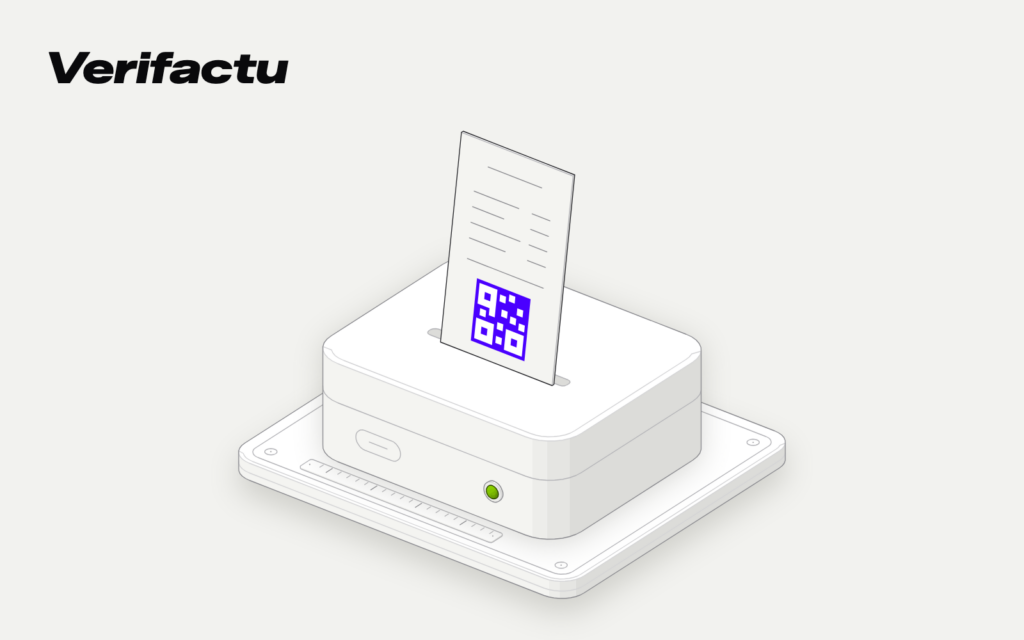
- The invoice has a QR code with some of its data, so your customer can check it with the Tax Agency.
- The manufacturer signs a declaration of compliance stating that its software complies, and this must be visible in the software itself.
There are two ways to comply. In the first, the software sends the Tax Agency the record for each invoice in real time, and the invoice includes the phrase “Invoice verifiable on the AEAT electronic site”. This is the option that gives its name to all of this, VERI*FACTU. In the second, the software stores the records electronically signed and delivers them to the Tax Agency if it asks for them.
The fines are serious. Having software that is not certified when it should be is punishable by €50,000 for each tax year. Anyone who makes or sells software that does not meet the requirements faces €150,000 for each tax year and for each type of software, and €1,000 for each software product sold without its certificate.
The two dates the BOE sets today
The date depends on how you are taxed. If your business is a company (an SL, for example), you pay Corporate Income Tax. If you are a freelancer, you pay Personal Income Tax and the second date applies to you.
| Who | Date set by the BOE | What the Tax Agency announces |
|---|---|---|
| Companies | Before January 1, 2027 | October 2028, not approved yet |
| Freelancers and others | Before July 1, 2027 | October 2028, not approved yet |
Those dates are the ones in Royal Decree-Law 15/2025, published in the BOE on December 3, 2025, and ratified by Congress on December 11. The regulation text in the BOE still follows that version, and its last update is from December 3, 2025.
On October 5, 2026, the Ministry of Finance published a note announcing that it will postpone the pending obligations until October 2028. It wants them to coincide with mandatory e-invoicing for businesses that invoice less than 8 million a year. The Tax Agency lists it on its website as a forecast.
A press release does not change a royal decree. Until the delay is published in the BOE, the dates that count are those in 2027.
If it is approved, you will have more leeway, but the work will be the same. In the same note, the Tax Agency says the technical requirements will remain “substantially equivalent”, and the deadline for manufacturers to have their software adapted has already ended.
Until the date arrives, the Tax Agency considers the remaining time a testing period. You can try sending records and keep invoicing with your usual software.
Who is left out of Verifactu
It does not apply to everyone. According to the Tax Agency itself, these cases are left out.
- SII companies. The Immediate Supply of Information is the system in which some companies, either by obligation or by choice, keep their VAT ledgers on the Tax Agency website. Anyone in the SII does not have to comply with Verifactu, and vice versa.
- The Basque Country and Navarre. If you are taxed there under regional tax law, you follow the rules of your regional tax authority. In Álava, Gipuzkoa and Bizkaia, for example, TicketBAI is already in operation.
- Anyone who invoices by hand, with a receipt book or a typewriter, because they do not use any software.
- The special regime for agriculture, livestock and fishing, as a general rule, because under that regime you are almost never required to issue an invoice.
The Canary Islands, Ceuta and Melilla are included, with their own taxes instead of VAT.
If you invoice with Word or Excel
There is a lot of confusion here. The Tax Agency says Word and Excel do not count as invoicing software if you only use them to type in the data, print the invoice and save it.
It changes if the spreadsheet does something more with those invoices.
| How you invoice | Does Verifactu affect you? | What you need to do |
|---|---|---|
| Handwritten invoice book | No | Nothing, for now |
| Word or Excel only to write and print | No | Nothing, for now |
| Excel that generates your VAT ledger or accounting records | Yes | Comply like any other software |
| Invoicing software, POS or online store | Yes | Check that it is adapted |
If your spreadsheet has a macro that prepares the invoice logbook for you, for the Tax Agency it is already invoicing software and must meet the same requirements. The Tax Agency also warns that it can check what your spreadsheet actually does.
There is another reason to leave Word behind if you invoice businesses. With mandatory e-invoicing, starting October 6, 2028, invoices between businesses and freelancers will have to be a file with data organized in a standard format, and a PDF made in Word is not.
If you don't invoice much, the Tax Agency has a free invoicing app on its online portal that already complies with Verifactu. For a freelancer with few invoices a month, it may be enough.
What to do before the deadline
The first thing is to know which of your programs create invoices. The regulation defines invoicing software as the set of hardware and software you use to issue invoices. If you invoice from the online store, from the POS and from a desktop program, those are three things to review.
Then do this with each one.
- Ask the manufacturer for the declaration of compliance. If they don't give it to you, be wary.
- Ask which method it uses. Whether it sends each invoice to the Tax Agency or stores signed records.
- Check that it is updated to the version that complies, especially if you have it installed on your computer.
- Talk to your accountant if you are unsure whether you are taxed as a company or as a freelancer, or if you are in the SII.
If you only invoice, subscription-based invoicing software that already complies is enough for you. The problem appears when the invoice comes from custom software, or from several that don't talk to each other, because each one has to comply on its own. In custom ERP or SaaS you can see when each option is worth it.
If you manage orders, stock, and invoices in one system, in custom ERP you can see how we do it, and in pricing, everything else. We reply Monday to Friday, from 9:00 to 19:00, in under 2 hours.
Orders go in one program, stock in a spreadsheet and invoices are made by hand in another program that has not been updated.
Each invoice comes from the order, without copying data, and leaves its record with the QR code. The record is sent to the Tax Agency immediately, and a correction is made with a corrective invoice. Stock goes down with each sale and the dashboard shows the amount invoiced each week.
from€20,000
Sources
- Companies (taxpayers under art. 3.1.a, Corporate Income Tax) before January 1, 2027, BOE consulted on 3-Nov-2026
- Freelancers and other obligated parties before July 1, 2027 (3-Nov-2026)
- Art. 3.1.a covers Corporate Income Tax taxpayers (3-Nov-2026)
- Freelancers: IRPF taxpayers with economic activities (3-Nov-2026)
- It applies even if the software is used for only part of the activity (3-Nov-2026)
- Royal Decree 1007/2023, regulation on invoicing software systems (3-Nov-2026)
- Records cannot be altered without the software detecting it and issuing an alert (3-Nov-2026)
- Corrections are made with a new record (3-Nov-2026)
- The invoice includes a QR code with part of its content (3-Nov-2026)
- Phrase for the option that sends records to the Tax Agency (3-Nov-2026)
- The manufacturer signs a declaration of compliance stating that the software complies (3-Nov-2026)
- The declaration of compliance must be visible in the software itself (3-Nov-2026)
- VERI*FACTU systems do not have to sign records; the others do (3-Nov-2026)
- Invoicing software is the combination of hardware and software used to issue invoices (3-Nov-2026)
- The deadline for manufacturers was nine months from the development order (3-Nov-2026)
- The development order is Order HAC/1177/2024, published on 28-Oct-2024; nine months later, the deadline has passed (calculation; 3-Nov-2026)
- Last update of the regulation in the BOE, December 3, 2025 (3-Nov-2026)
- Royal Decree-Law 15/2025 sets January 1, 2027 and July 1, 2027 (3-Nov-2026)
- Published in the BOE on December 3, 2025 (3-Nov-2026)
- Ratified by Congress on December 11, 2025 (3-Nov-2026)
- Hacienda anuncia el 5 de octubre de 2026 el aplazamiento a octubre de 2028 (3-nov-2026)
- Until October 2028, to align with e-invoicing for those invoicing up to 8 million (3-Nov-2026)
- The requirements will remain in substantially equivalent terms (3-Nov-2026)
- The Tax Agency presents it as a forecast (page updated on 3-Nov-2026)
- The Tax Agency page is updated as of November 3, 2026
- Until the deadline, it is a testing period (3-Nov-2026)
- Fine of €50,000 per year for having uncertified software (LGT, art. 201 bis; 3-Nov-2026)
- Fine of €150,000 per year and per type of software for anyone who makes or sells non-compliant software (3-Nov-2026)
- Fine of €1,000 for each program sold without certification (LGT, art. 201 bis.4; 3-Nov-2026)
- Those in SII do not comply with Verifactu, and vice versa (3-Nov-2026)
- SII can be chosen voluntarily (3-Nov-2026)
- Excluded: those taxed under regional law in the Basque Country or Navarra (3-Nov-2026)
- In Guipúzcoa, Vizcaya and Álava, TicketBAI applies (3-Nov-2026)
- Excluded: those who invoice by hand (3-Nov-2026)
- Agriculture, livestock and fishing scheme, generally excluded (3-Nov-2026)
- Canary Islands, Ceuta and Melilla are included, with IGIC and IPSI (3-Nov-2026)
- Word and Excel do not count if they are only used to write, print and save (3-Nov-2026)
- An Excel with a macro that generates the ledger does count as invoicing software (3-Nov-2026)
- The Tax Agency can check what the spreadsheet does (3-Nov-2026)
- E-invoicing between businesses mandatory for the rest from October 6, 2028 (3-Nov-2026)
- E-invoicing is a structured message in a standard format (Royal Decree 238/2026, art. 7; 3-Nov-2026)
- Free invoicing app from the Tax Agency (3-Nov-2026)
- The Tax Agency app counts as a VERI*FACTU system (3-Nov-2026)
- The date changed in April 2025 (Royal Decree 254/2025) and in December 2025 (3-Nov-2026)
- SII means keeping VAT ledgers on the Tax Agency's portal (3-Nov-2026)